
Part 2 of 3 in our reflections on Models of Awareness
There are two ways of moving through the world.
There is the world of expression - speaking, doing, serving, acting, creating. And there is the world of reflection - sensing, feeling, dwelling, listening, noticing. One moves outward; the other moves inward. Most of us are drawn more naturally toward one than the other. Some of us come alive out in the open, expressing what's in us and making things happen. Others come alive in the quiet, feeling their way toward what is true.
Neither orientation is wrong. We need both. But much of our fatigue - and some of our deepest stuckness - comes from getting caught in one cycle and avoiding movement into the other.
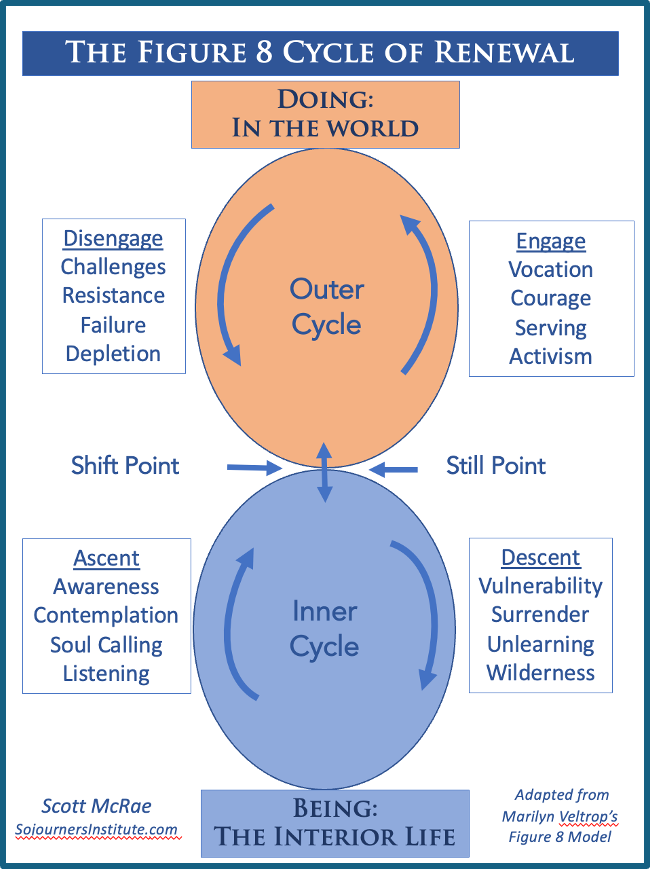
The Figure 8 Cycle of Renewal
The Figure 8 Cycle of Renewal above provides a mirror for noticing our outward and inward patterns. It contrasts two essential movements of life: doing and being, expression and reflection.
The Outer Cycle represents our movement into the world - engaging our vocation, finding courage, serving, and acting on what matters to us. But outward engagement also brings challenges, resistance, and failure. If we remain in this cycle too long, depletion follows.
The Inner Cycle represents movement into our interior life - awareness, contemplation, listening, and attending to the deeper callings of the soul. Here we encounter a different kind of terrain: vulnerability, surrender, unlearning, and sometimes the wilderness of not knowing.
At the center of the figure are two important thresholds.
The Shift Point marks the place where we consciously choose to move from one cycle into the other. It’s an intentional decision.
The Still Point is a contemplative experience. It’s the pause where we can step out of momentum, listen, and sense what movement is needed next.
The Figure 8 as a whole reflects a dynamic cycle of movement. It suggests that renewal isn't about staying permanently in either the outer or inner world. It is about learning the rhythm of engaging and disengaging, acting and listening, giving and receiving - and becoming aware of when it is time to cross from one cycle into the other.
Caught in the Outer Cycle
When we're oriented toward expression, we naturally move outward. We engage. We speak up. We serve. We create. We act on what matters to us. This is the yang energy of Taoist philosophy.
And this outward activity naturally meets a counterforce that we experience as resistance - challenges, disappointment, conflict, sometimes failure. All of this costs energy. If we stay in the Outer Cycle without pausing to replenish ourselves, we eventually begin spending more than we're taking in. What began as purposeful engagement can slowly become obligation, overextension, and a hollowed-out kind of tired.
Consider Amelia. She is the person everyone counts on. She says yes when someone needs help, volunteers for the committee, takes on the extra project at work, remembers everyone's birthday, and somehow finds time to organize the neighborhood gathering. She genuinely loves being useful, and much of what she does is meaningful. But lately she feels like she’s been hit by a truck. She clearly sees how her generosity has a price. She is tired before the day begins. Even things she once enjoyed feel like one more thing on the list. When someone asks how she is doing, she says, "Fine," while quietly wondering how much longer she can keep going.
Amelia doesn't necessarily need to do less because doing is bad. She needs to recognize that her outward cycle has become a closed loop. She is giving, responding, producing, and pushing forward without allowing anything to come back in. Her next movement may not be another act of service. It may be a movement inward, to disengage, listen, rest, and allow herself to receive.
Caught in the Inner Cycle
The Inner Cycle moves differently. We notice. We listen. We feel. We sit with what is happening inside us. We turn things over. This inward attention is necessary and often the place where genuine insight begins. This the Tao’s yin energy.
But reflection has its own undertow. Left too long unchecked, it can become rumination. We stop listening to our experience and start circling it. We become absorbed in what we feel rather than allowing what we feel to move us toward something new.
Consider Phil. He has a rich inner life. He journals every morning, reads widely, meditates, and spends a great deal of time trying to understand himself. He is thoughtful about his relationships and careful about the decisions he makes. But lately his reflection has become a kind of holding pattern. He keeps thinking about the conversation he needs to have, the project he wants to begin, and the changes he knows he needs to make. He can explain exactly why each one matters. Yet somehow he never quite gets around to doing anything about them.
Phil's challenge isn't a lack of awareness. He may actually be over-aware without movement. His inner life has become so absorbing that it keeps him from reentering the world. What he may need isn't more reflection but a small act of expression - a phone call, a decision, a first step. An outward movement may be the liberating factor in his life.
The Shift Point
Renewal begins when we recognize that we are circling the same loop and become willing to cross into the other one. The Shift Point is where awareness becomes choice.
Usually, this isn't a dramatic moment. More often, it begins with a quiet recognition: I'm running on empty. Or, I've been thinking about this for months, but I'm not moving. We begin to notice not only what we're doing but what our current pattern is costing us.
The shift asks simple but surprisingly powerful questions: What do I need now? Or, What is life asking of me at this time? Sometimes the answer is movement: make the call, have the conversation, take the risk, begin the project. Other times the answer is stillness: step back, breathe, rest, listen, feel, wait.
The Shift Point is not about judging one cycle as healthy and the other as unhealthy. It is about recognizing when a cycle has stopped serving its purpose. Amelia may need to step out of doing and into being. Phil may need to step out of reflection and into action. For both, the shift begins when they stop asking, How do I keep doing what I'm doing? and start asking, What is needed next?
The Still Point
At the center of the Figure 8 we also find the Still Point. It is the pause between movements, the place where we are no longer completely driven by the momentum of the cycle we've been in. We don't have to immediately know what comes next. We can simply stop long enough to notice, breathe, listen, and become available to something new.
This is close to what the Tao Te Ching points toward with the idea of wu wei, often translated as "effortless effort." It doesn't mean doing nothing or withdrawing from life. Rather, it suggests action that isn't driven by grasping or forcing. At the Still Point, being and doing begin to work together. We can act without striving and rest without withdrawing. We can listen without becoming passive and move without abandoning ourselves.
The Still Point is also where we discover that renewal doesn't always come from figuring something out. Sometimes it comes from creating enough space for something to become clear. We don't have to push the next thing into existence. We can pause, listen, and allow the next movement to emerge.
Renewal
Renewal, then, isn't a permanent state of balance. It is a rhythm. We move outward into expression and inward into reflection. We engage and disengage. We give and receive. We act and listen. Yin is nourished by yang, and yang by yin. Each movement contains something the other needs.
Sometimes renewal looks like stepping away from a demanding season of work. Sometimes it looks like saying no to something good because we recognize that we have nothing left to give. Sometimes it looks like an afternoon with no agenda, a walk without headphones, or sitting quietly long enough to hear what has been drowned out by the noise of the day. And sometimes renewal looks like getting up from the meditation cushion and finally doing the thing we've been thinking about for six months.
The Figure 8 reminds us that life isn't a straight line. We don't graduate from the Outer Cycle into the Inner Cycle, or vice versa. We circle, cross, return, and begin again. The goal isn't to find the perfect place to stay. It is to become increasingly aware of where we are, what the current cycle is asking of us, and when it is time to move.
Perhaps that is the deeper meaning of renewal: not finding a place where we can finally settle in forever but learning the rhythm of leaving one place and entering another.
Points to Ponder
Which orientation comes more naturally to you—expression or reflection?
Where in your life might you be circling the same loop for too long?
What are the signs that tell you it is time to shift?
What might your Still Point look like—not as an escape from life, but as a place where you can listen more deeply?
And what small movement, outward or inward, might bring a little renewal today?